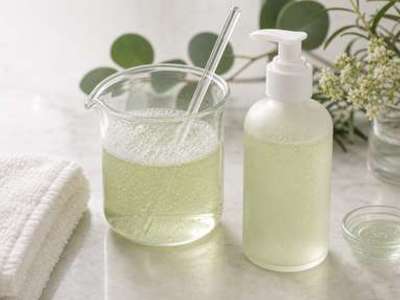
Beginner
Shower gel
Gentle shower gel with SugaNate
Indicative gentle body cleansing formula with SugaNate 160NC as the main anionic surfactant.
About this recipe. A gentle, fragrance-free shower gel for evaluating SugaNate 160NC as a plant-derived anionic surfactant within a system combined with an amphoteric surfactant and glucosides.
Why these ingredients are used.
- Distilled or deionised water is the main vehicle.
- Glycerine improves the feel during use and helps disperse the gum.
- Transparent xanthan gum adds body without aiming for an excessively thick texture.
- SugaNate 160NC provides the anionic cleansing base and foam.
- Coco Betaine helps balance mildness and foam.
- Decyl Glucoside and Coco Glucoside complete the cleansing system.
- Geogard 221 / Cosgard protects the formula within its usage and pH range.
It must be tested and validated before use or marketing, checking pH, viscosity, stability, preservation, container compatibility and tolerance.
Base formula
| Include | Product | % | Quantity | Price / pack size |
|---|---|---|---|---|
| Gelled aqueous phase | ||||
| Distilled or deionised water | 59.85 % | 598.5 g | Manual addition | |
| Liquid vegetable glycerine | 3 % | 30 g | €0.70 used (1 x 125 g · purchase €2.90) Approx. leftover 95 g | |
| Clear Xanthan Gum | 0.35 % | 3.5 g | €0.41 used (1 x 30 g · purchase €3.50) Approx. leftover 26.5 g | |
| Surfactants | ||||
| SugaNate 160NC | 14 % | 140 g | €4.66 used (1 x 250 ml · purchase €8.33) Approx. leftover 110 ml | |
| Coco Betaine | 10 % | 100 g | €1.96 used (1 x 125 ml · purchase €2.45) Approx. leftover 25 ml | |
| Decyl Glucoside | 8 % | 80 g | €1.86 used (1 x 125 ml · purchase €2.90) Approx. leftover 45 ml | |
| Coco Glucoside | 4 % | 40 g | €1.06 used (1 x 125 ml · purchase €3.30) Approx. leftover 85 ml | |
| Preservation and pH | ||||
| Geogard 221 / Cosgard | 0.8 % | 8 g | €1.64 used (1 x 10 ml · purchase €2.05) Approx. leftover 2 ml | |
| Citric acid in a 20% solution | 0 % | 0 c.n. | Manual addition | |
Step by step



Preservation, shelf life and validation
- Work with clean, disinfected utensils. Avoid whisking the surfactants so that excessive foam does not form during manufacture.
- Always measure the final pH before considering the formula finished. Do not use the recipe on children, mucous membranes or the eye area without specific validation.
Questions, improvements and possible corrections
If you have a question about this recipe, notice a possible error or would like to suggest an improvement, please let us know here.