Advanced
Creams
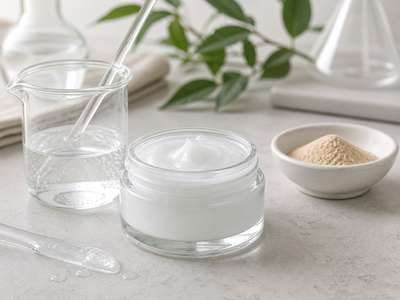
Light gel-cream stabilised with Siligel
Light O/W emulsion in which Siligel acts as a stabiliser and enhances the sensory feel of the aqueous phase.
About this recipe. A light gel-cream for testing Siligel in an O/W emulsion. Here it is not used only to thicken water: it acts as a stabiliser for the aqueous phase, provides rheology support and improves the sensory feel of a fluid cream.
Why these ingredients are used.
- Siligel helps reinforce the emulsion structure and improve feel.
- Olivem 1000 MB/RSPO creates the main emulsion.
- Isoamyl Laurate provides spreadability and a silky feel without an excessively greasy sensation.
- Cetyl alcohol improves body, stability and a conditioned feel.
- Glycerine and D-Panthenol W75 complete the humectant and comfort components.
- Geogard 221 / Cosgard preserves the aqueous formula once the pH has been adjusted.
This is a starting formula. It must be tested for stability, centrifugation if available, temperature cycling, pH, smell, colour, viscosity and container compatibility.
Base formula
| Include | Product | % | Quantity | Price / pack size |
|---|---|---|---|---|
| Structured aqueous phase | ||||
| Distilled or deionised water | 79 % | 79 g | Manual addition | |
| Liquid vegetable glycerine | 3 % | 3 g | €0.07 used (1 x 125 g · purchase €2.90) Approx. leftover 122 g | |
| Siligel - Natural gelling agent | 0.7 % | 0.7 g | €0.40 used (1 x 10 g · purchase €5.65) Approx. leftover 9.3 g | |
| Oil phase | ||||
| Olivem 1000 MB/RSPO | 5 % | 5 g | €0.74 used (1 x 50 g · purchase €7.35) Approx. leftover 45 g | |
| Isoamyl Laurate | 8 % | 8 g | €0.57 used (1 x 60 ml · purchase €4.30) Approx. leftover 52 ml | |
| Cetyl Alcohol MB/RSPO | 1.5 % | 1.5 g | €0.07 used (1 x 50 g · purchase €2.25) Approx. leftover 48.5 g | |
| Cooling and adjustment | ||||
| D-Panthenol W75 | 2 % | 2 g | €0.36 used (1 x 25 g · purchase €4.45) Approx. leftover 23 g | |
| Geogard 221 / Cosgard | 0.8 % | 0.8 g | €0.16 used (1 x 10 ml · purchase €2.05) Approx. leftover 9.2 ml | |
| 20% citric acid solution | 0 % | 0 c.n. | Manual addition | |
Step by step





Preservation, shelf life and validation
- Indicative cosmetic emulsion formula. Validate stability before prolonged use.
- Work with strict hygiene and disinfected containers.
- Do not heat above 80 °C when Siligel is part of the aqueous phase.
Questions, improvements and possible corrections
If you have a question about this recipe, notice a possible error or would like to suggest an improvement, please let us know here.