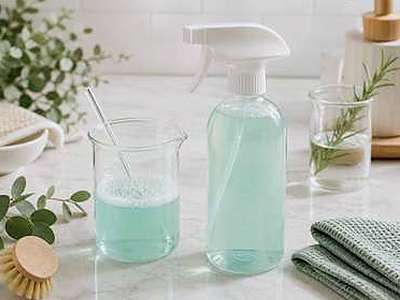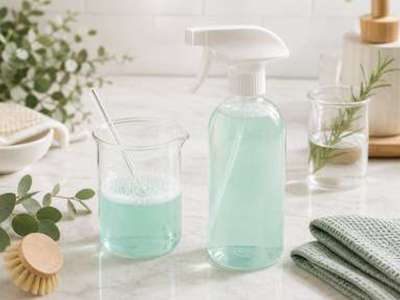
Gentle cleansing spray for washable surfaces with Coco Glucoside
Suggested household cleaning formula for washable surfaces, without disinfectant properties.
Formula objective. An aqueous cleansing spray for washable surfaces in which Coco Glucoside is used as the main cleaning agent. It is intended as an indicative household formula, not as a cosmetic or disinfectant.
Why these ingredients were chosen.
- Coco Glucoside helps solubilise light dirt and superficial greasy residues through its surfactant action.
- Water acts as the vehicle and allows convenient spray application.
- A low surfactant level avoids excess foam during use and makes removal with a damp cloth easier.
- The preservative is included to protect the aqueous mixture during storage.
- Citric acid allows the pH to be adjusted when necessary, always checking surface compatibility.
Intended users. Formulators who want to trial a gentle cleaner for washable, non-delicate surfaces. It is not intended for marble, acid-sensitive natural stone, untreated wood or screens.
Skill level. Easy level: weighing, mixing and packaging are sufficient, but it must be clearly labelled as a household cleaner and tested on a small area first.
Validation required. Check pH, stability, smell, spray-container compatibility and performance on each surface. It does not replace registered biocidal products or disinfectants.
Base formula
| Include | Product | % | Quantity | Price / pack size |
|---|---|---|---|---|
| Gelled aqueous phase | ||||
| Distilled or deionised water | 78.2 % | 782 g | Manual addition | |
| Surfactants | ||||
| Coco Glucoside | 8 % | 80 g | €2.11 used (1 x 125 ml · purchase €3.30) Approx. leftover 45 ml | |
| Decyl Glucoside | 5 % | 50 g | €1.16 used (1 x 125 ml · purchase €2.90) Approx. leftover 75 ml | |
| Denatured Alcohol 96º | 8 % | 80 g | Manual addition | |
| Preservation and pH adjustment | ||||
| Geogard 221 / Cosgard | 0.8 % | 8 g | €1.64 used (1 x 10 ml · purchase €2.05) Approx. leftover 2 ml | |
| Citric acid in a 20% solution | 0 % | 0 c.n. | Manual addition | |
Step by step




Preservation, shelf life and validation
- Work with clean, disinfected utensils. Avoid whisking the surfactants so that excessive foam does not form during manufacture.
- Always measure the final pH before considering the formula finished. Do not use the recipe on children, mucous membranes or the eye area without specific validation.
Questions, improvements and possible corrections
If you have a question about this recipe, notice a possible error or would like to suggest an improvement, please let us know here.