Foaming bath powder with SLSA
Beginner
Bath powders

Foaming bath powder with SLSA

Indicative anhydrous formula for bath foam with SLSA.

Save to favourites

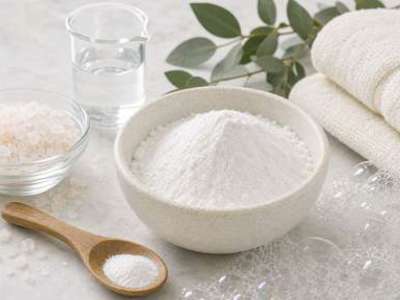
Formula objective. An anhydrous bath powder with SLSA as the foaming agent. The formula aims for a dry base that disperses in bathwater, generates foam and gives a pleasant feel without needing to preserve an aqueous phase.

Why these ingredients were chosen.

  • SLSA is the main ingredient because it provides foam in a solid, dry format.
  • Bicarbonate and citric acid form an effervescent base that promotes dispersion in water.
  • Starch improves the feel of the powder and helps reduce clumping.
  • White clay adds body and a silky feeling in the bath.
  • Vegetable oil is used at a low level to improve sensory feel without wetting the system or activating the effervescent reaction.

Intended users. Users seeking a powdered foaming bath suggestion. It is not recommended for young children, eyes, mucous membranes or irritated skin without specific validation.

Skill level. Easy level: requires neither heating nor emulsification, but does require dry working conditions, avoiding SLSA inhalation and immediate packaging in a container protected from moisture.

Validation required. Validate behaviour in the presence of moisture, powder flow, foam, dispersion, absence of clumping and tolerance. Always keep dry.

Base formula

Include Product % Quantity Price / pack size
Base powders
Sodium Bicarbonate
50 % 250 g €1.70 used (1 x 250 g · purchase €1.70) Approx. leftover 0 g · fully used
Citric Acid
25 % 125 g €2.90 used (1 x 125 g · purchase €2.90) Approx. leftover 0 g · fully used
Maize Starch
10 % 50 g €1.95 used (1 x 50 g · purchase €1.95) Approx. leftover 0 g · fully used
White Kaolin Clay
4 % 20 g €0.42 used (1 x 125 g · purchase €2.65) Approx. leftover 105 g
Foaming agent and finish
SLSA
10 % 50 g Pack sizes are available, but they are currently out of stock.
Sweet Almond Oil
1 % 5 g €0.12 used (1 x 125 ml · purchase €2.95) Approx. leftover 120 ml

Step by step

Prepare and sieve the powders 1 Room temperature

Prepare and sieve the powders

Before starting, prepare a large, clean and completely dry container. This matters because the recipe contains citric acid and bicarbonate: if moisture enters too early, the mixture may start to react.

Put on a mask, goggles and gloves before handling SLSA or any fine powder. This is not about making the recipe complicated; it simply avoids inhaling particles while weighing and mixing.

Now sieve the bicarbonate, citric acid, starch and clay. Do this slowly, without hitting the sieve hard, so that the powders remain loose and free from lumps.

Incorporate the SLSA without raising dust 2 Room temperature

Incorporate the SLSA without raising dust

Now add the SLSA with slow folding movements. Do not whisk it or stir energetically: the idea is to incorporate it gradually, raising as little powder as possible.

If you see an area with a large accumulation of SLSA, gently press it with the spatula against the powder mixture and fold again. It is better to take an extra minute than to create a cloud of powder on the worktop.

Add the oil gradually 3 Room temperature

Add the oil gradually

Once the previous mixture is incorporated, add the Sweet Almond Oil drop by drop or in a very thin stream. Adding it slowly distributes it much more evenly and avoids greasy clumps forming in one area.

Mix after each small addition. The final texture should remain a loose powder, slightly silkier to the touch, but neither damp nor clumped.

If you notice compacted areas when pressing with the spatula, break up these small lumps and keep mixing until the appearance is uniform.

Check the pH at the use concentration and package Final

Check the pH at the use concentration and package

As this is an anhydrous formula, pH is not measured directly on the dry powder. The correct approach is a small use test: take a representative sample, for example 1 g of product, and disperse it in 9 g of lukewarm water.

Stir gently, wait a few minutes and check the pH with strips or a calibrated meter. For a bath product, aim for the dispersion to be within a comfortable range for the skin; if the result is too far outside this, do not scale up the recipe until it has been corrected and validated.

When the test is satisfactory, package immediately in a clean, dry, tightly closed container. Protect the product from moisture, as any water ingress may activate the mixture and spoil the texture.

Before preparing large quantities, keep a small sample sealed for a few days and observe whether it clumps, loses its free-flowing quality, changes smell or reacts inside the container.

Preservation, shelf life and validation

  • Handle SLSA without inhaling the powder. Wear a mask, goggles and gloves during weighing and mixing.
  • Do not add water during preparation. Keep utensils, the worktop, container and hands completely dry.
  • Anhydrous product: package in a dry container, tightly closed and protected from moisture.

Questions, improvements and possible corrections

If you have a question about this recipe, notice a possible error or would like to suggest an improvement, please let us know here.
We review messages before publishing them. Please do not include personal data or medical questions; if the answer could help others, we will publish it as an answered question.