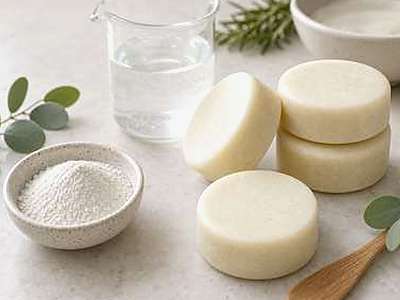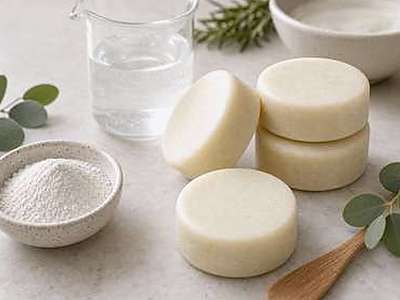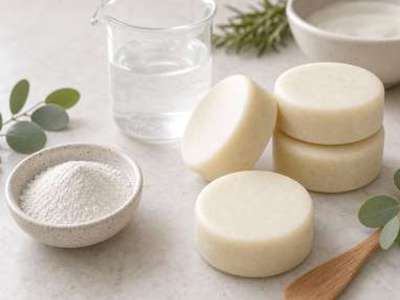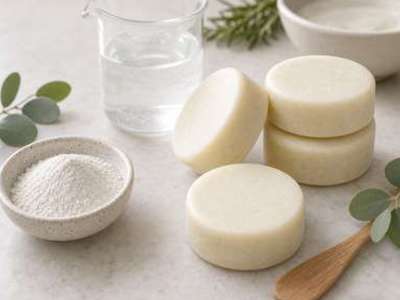
Solid syndet facial cleanser with SCI
Indicative solid facial cleanser formula with SCI and a mild powder phase.
Formula objective. A solid syndet facial cleanser with SCI as the cleansing base. The formula aims for a gentle rinse-off facial bar, with a lower detergent content than a solid body or hair product.
Why these ingredients were chosen.
- SCI is used as the main surfactant for its creamy foam and good performance in solid formats.
- The structuring ingredients allow a manageable bar to form without increasing hardness too much.
- The emollient fraction helps improve slip and comfort during massage.
- The overall surfactant level should remain cautious because it is intended for facial use.
- The pH of the dispersion is critical for evaluating skin compatibility.
Intended users. Normal or combination skin that tolerates rinse-off cleansers. For sensitive or reactive skin, or a compromised barrier, particular caution and very small trials are recommended.
Skill level. Advanced level: although the formula seems simple, a solid facial format requires control of powder, compaction, pH, hardness and the feel after rinsing.
Validation required. Validate pH, tolerance, hardness, drying, foam, cleansing action, stability against moisture and preservation during use.
Base formula
| Include | Product | % | Quantity | Price / pack size |
|---|---|---|---|---|
| Powders and surfactants | ||||
| Microfiltered SCI | 35 % | 35 g | Pack sizes are available, but they are currently out of stock. | |
| Disodium Cocoyl Glutamate powder | 8 % | 8 g | €0.90 used (1 x 50 g · purchase €5.65) Approx. leftover 42 g | |
| White Kaolin Clay | 20 % | 20 g | €0.42 used (1 x 125 g · purchase €2.65) Approx. leftover 105 g | |
| Maize Starch | 15 % | 15 g | €0.59 used (1 x 50 g · purchase €1.95) Approx. leftover 35 g | |
| Melted phase | ||||
| Cetyl Alcohol | 6 % | 6 g | €0.27 used (1 x 50 g · purchase €2.25) Approx. leftover 44 g | |
| Virgin Jojoba Oil | 5 % | 5 g | €0.66 used (1 x 30 ml · purchase €3.95) Approx. leftover 25 ml | |
| Liquid vegetable glycerine | 5 % | 5 g | €0.12 used (1 x 125 g · purchase €2.90) Approx. leftover 120 g | |
| D-Panthenol W75 | 2 % | 2 g | €0.36 used (1 x 25 g · purchase €4.45) Approx. leftover 23 g | |
| Distilled or deionised water | 3.2 % | 3.2 g | Manual addition | |
| Geogard 221 / Cosgard | 0.8 % | 0.8 g | €0.16 used (1 x 10 ml · purchase €2.05) Approx. leftover 9.2 ml | |
Step by step




Preservation, shelf life and validation
- Handle powdered surfactants with a mask, goggles and gloves. Avoid raising dust while weighing and mixing.
- Measure the pH in an aqueous dispersion before validating the bar. Do not seal it in airtight packaging until the product is sufficiently hard and dry.
Questions, improvements and possible corrections
If you have a question about this recipe, notice a possible error or would like to suggest an improvement, please let us know here.