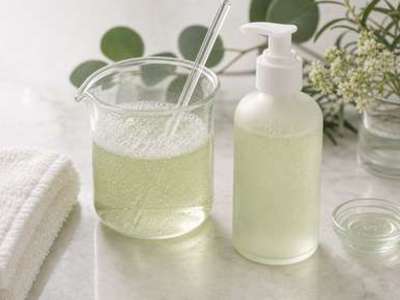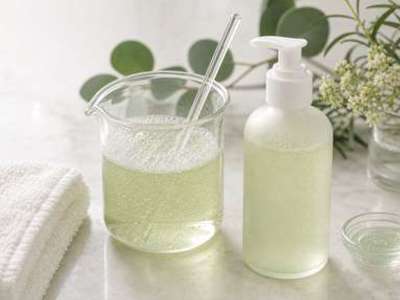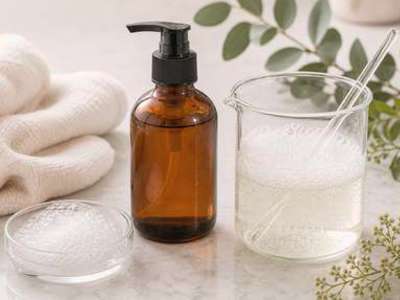
Liquid hand soap with Disodium Cocoamphodiacetate
Formula for frequent use in which the amphoteric surfactant helps balance mildness and foam.
Formula objective. A liquid hand soap with Disodium Cocoamphodiacetate as the basis for mildness. It is designed for frequent use, with moderate cleansing and a less dry feel than more detergent systems.
Why these ingredients were chosen.
- Disodium Cocoamphodiacetate contributes to a gentler feel during washing.
- Supporting non-ionic or amphoteric surfactants improve foam and rinsing without aiming for excessive detergency.
- Glycerine provides humectancy and improves comfort with repeated washing.
- The preservative protects the aqueous formula against contamination from daily use.
- pH adjustment helps keep the cosmetic formula compatible with the skin of the hands.
Intended users. Users who need a gentle hand cleanser for everyday use. It is not formulated as a sanitiser or disinfectant and must not be described as one.
Skill level. Easy level: requires correct weighing, slow mixing, pH measurement and resting before packaging.
Validation required. Validate preservation, pH, foam, smell, stability and tolerance with repeated washing.
Base formula
| Include | Product | % | Quantity | Price / pack size |
|---|---|---|---|---|
| Gelled aqueous phase | ||||
| Distilled or deionised water | 68.2 % | 682 g | Manual addition | |
| Liquid vegetable glycerine | 3 % | 30 g | €0.70 used (1 x 125 g · purchase €2.90) Approx. leftover 95 g | |
| Clear Xanthan Gum | 0.4 % | 4 g | €0.47 used (1 x 30 g · purchase €3.50) Approx. leftover 26 g | |
| Surfactants | ||||
| Disodium Cocoamphodiacetate | 10 % | 100 g | €1.65 used (1 x 100 ml · purchase €1.65) Approx. leftover 0 ml · fully used | |
| Coco Glucoside | 12 % | 120 g | €3.17 used (1 x 125 ml · purchase €3.30) Approx. leftover 5 ml | |
| Decyl Glucoside | 5.6 % | 56 g | €1.30 used (1 x 125 ml · purchase €2.90) Approx. leftover 69 ml | |
| Preservation and pH adjustment | ||||
| Geogard 221 / Cosgard | 0.8 % | 8 g | €1.64 used (1 x 10 ml · purchase €2.05) Approx. leftover 2 ml | |
| Citric acid in a 20% solution | 0 % | 0 c.n. | Manual addition | |
Step by step




Preservation, shelf life and validation
- Work with clean, disinfected utensils. Avoid whisking the surfactants so that excessive foam does not form during manufacture.
- Always measure the final pH before considering the formula finished. Do not use the recipe on children, mucous membranes or the eye area without specific validation.
Questions, improvements and possible corrections
If you have a question about this recipe, notice a possible error or would like to suggest an improvement, please let us know here.