Advanced
Creams
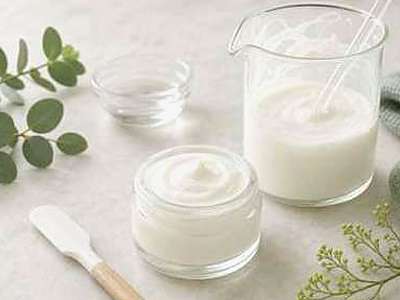
Classic body cream with Self-Emulsifying Monostearate
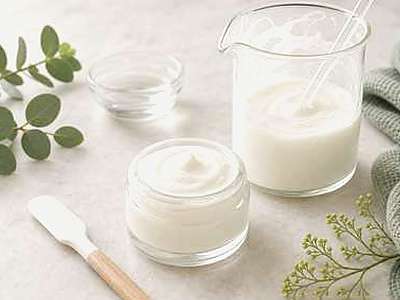
Simple O/W cream with self-emulsifying monostearate as the main base.
A classic body cream for evaluating Self-emulsifying Monostearate as an O/W base, with a creamy structure and a formula that is very easy to understand.
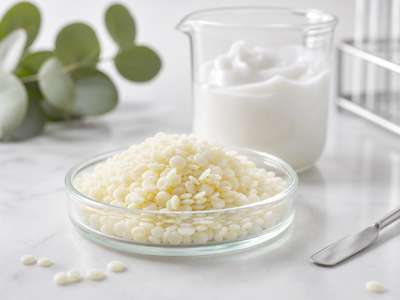
The main ingredient is Self-emulsifying Glyceryl Monostearate: although it is not the largest component by weight, it is what enables the emulsion, texture or dispersion to form. This is why the recipe makes sense as a formula specific to this product.
Why it is designed this way:
- Self-emulsifying Monostearate is used at 5% as the main emulsifier.
- The oil phase at 18% allows stability and body to be checked without making it a heavy cream.
- Xanthan stabilises the aqueous phase without being mainly responsible for the texture.
- This is a good learning recipe for practising hot-process emulsification.
Intermediate level: requires accurate weighing, temperature control when making a hot-process emulsion, and validation of the finished formula. Before scaling up or marketing, check stability, pH where applicable, viscosity, smell, colour, preservation and container compatibility.
Base formula
| Include | Product | % | Quantity | Price / pack size |
|---|---|---|---|---|
| Aqueous phase | ||||
| Distilled water | 71.95 % | 71.95 g | Manual addition | |
| Vegetable glycerine | 4 % | 4 g | €0.09 used (1 x 125 g · purchase €2.90) Approx. leftover 121 g | |
| Clear Xanthan Gum | 0.25 % | 0.25 g | €0.03 used (1 x 30 g · purchase €3.50) Approx. leftover 29.75 g | |
| Oil phase / emulsifier | ||||
| Self-emulsifying Glyceryl Monostearate | 5 % | 5 g | €0.34 used (1 x 50 g · purchase €3.40) Approx. leftover 45 g | |
| Sweet Almond Oil | 10 % | 10 g | €0.24 used (1 x 125 ml · purchase €2.95) Approx. leftover 115 ml | |
| Coco Caprylate / Caprate | 8 % | 8 g | €0.58 used (1 x 50 ml · purchase €3.60) Approx. leftover 42 ml | |
| Final phase | ||||
| Geogard 221 / Cosgard Preservative | 0.8 % | 0.8 g | €0.16 used (1 x 10 ml · purchase €2.05) Approx. leftover 9.2 ml | |
Step by step







Preservation, shelf life and validation
- Indicative formula for external cosmetic use. Disinfect utensils and the container, work hygienically and do not touch the finished cream with your hands.
- As it contains water, it needs a preservative and microbiological validation if it is to be stored or marketed.
Questions, improvements and possible corrections
If you have a question about this recipe, notice a possible error or would like to suggest an improvement, please let us know here.