Shaving powder with Disodium Cocoyl Glutamate
Advanced
Shaving

Shaving powder with Disodium Cocoyl Glutamate

Dry powder for preparing a fresh shaving cream just before use.

Save to favourites
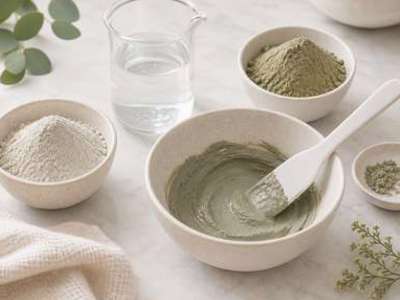
Suggested shaving powder in which Disodium Cocoyl Glutamate provides cleansing and foam, while oats, bentonite and starch create a creamier paste with better slip. The recipe is kept dry in its container and only the portion needed for use is activated. This avoids a preserved aqueous formula and makes use of the surfactant's powder form. It should be tested in small amounts, especially on the beard or sensitive areas, because shaving combines friction, wet skin and mechanical removal.

Base formula

Include Product % Quantity Price / pack size
Dry blend
Disodium Cocoyl Glutamate
33 % 33 g €3.73 used (1 x 50 g · purchase €5.65) Approx. leftover 17 g
Colloidal Oatmeal
29 % 29 g €3.13 used (1 x 50 g · purchase €5.40) Approx. leftover 21 g
Maize Starch
20 % 20 g €0.78 used (1 x 50 g · purchase €1.95) Approx. leftover 30 g
Bentonite Clay
16 % 16 g €0.35 used (1 x 125 g · purchase €2.70) Approx. leftover 109 g
Anhydrous citric acid
2 % 2 g €0.05 used (1 x 125 g · purchase €2.90) Approx. leftover 123 g

Step by step

Prepare the area and protect yourself from dust 1 Room temperature

Prepare the area and protect yourself from dust

Before starting, clean the worktop, dry the utensils thoroughly and prepare a completely dry jar. In powder recipes, moisture is the silent enemy: it causes clumping, changes the texture and can make the mixture keep less well.
Wear a mask and avoid working in draughts. Disodium Cocoyl Glutamate is a powdered surfactant; avoid inhaling it while weighing or mixing it.

Weigh the main surfactant 2 Room temperature

Weigh the main surfactant

Weigh the Disodium Cocoyl Glutamate first. This confirms from the start that the formula centres on this ingredient and that it does not serve merely as a supporting ingredient.
Add it to the container slowly, without tapping the spoon or beaker. If you see powder in the air, wait a few seconds before continuing.

Incorporate the supporting powders 3 Room temperature

Incorporate the supporting powders

Now add the remaining powders one at a time. The supporting powders are not there as “fillers”: they help make the product more pleasant to apply, less concentrated on the skin and easier to dose.
Fold the mixture gently. Aim for uniformity, not speed.

Sieve and homogenise 4 Room temperature

Sieve and homogenise

Sieve the mixture if you see lumps. This step may seem minor, but it makes a substantial difference to the experience of use: a fine powder hydrates better and leaves fewer concentrated particles.
Mix again after sieving so that the acid, if included in the recipe, is evenly distributed.

Prepare a test portion 5 Room temperature

Prepare a test portion

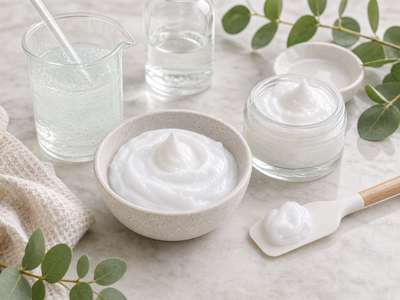
Do not hydrate the whole jar. Take a small amount in a separate bowl and add water drop by drop until you achieve the texture you want for a creamy shaving paste.
Once you add water, the product is no longer a dry mixture. Use that portion immediately and discard any leftovers.

Check the pH of the dispersion 6 Room temperature

Check the pH of the dispersion

Prepare a test dispersion and measure the pH. Indicative target: pH 6,0-7,0 in the hydrated paste.
This is particularly important with Disodium Cocoyl Glutamate: if you work below pH 7,5, the technical data sheet indicates that the INCI changes to Sodium Cocoyl Glutamate. This is not a decorative detail; it affects how you document and validate the formula.

Use and assess the feel Final Room temperature

Use and assess the feel

Apply gently and rinse with plenty of water. The first test should be small: this allows you to assess foam, rinsing, the final feel and tolerance without committing a large batch.
If you notice itching, irritation or an overly intense sensation, rinse immediately and reformulate by reducing the surfactant content or adjusting the pH.

Preservation, shelf life and validation

  • Indicative formula for external, rinse-off use. Avoid inhaling the powder during weighing and mixing; wear a mask if preparing a quantity.
  • Keep the main jar completely dry. Once water is added, the prepared portion must be used immediately and must not be stored.
  • Do not apply to irritated skin, wounds, mucous membranes or the eye area. Remove if itching, excessive heat or discomfort occurs.

Questions, improvements and possible corrections

If you have a question about this recipe, notice a possible error or would like to suggest an improvement, please let us know here.
We review messages before publishing them. Please do not include personal data or medical questions; if the answer could help others, we will publish it as an answered question.