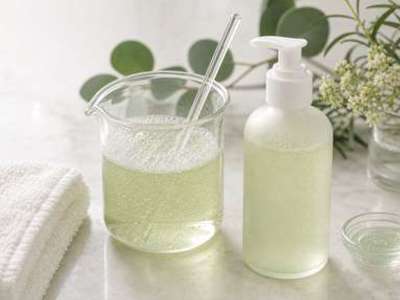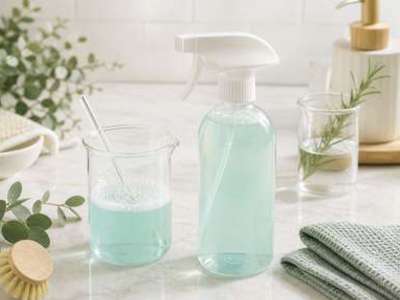
Gentle washing-up liquid with Decyl Glucoside
Suggested household cleaning formula for hand dishwashing, not for automatic dishwashers.
Formula objective. An indicative hand dishwashing liquid with Decyl Glucoside as the main surfactant. The suggestion aims to evaluate hand dishwashing with a glucoside system, keeping the formula simple and easy to adjust.
Why these ingredients were chosen.
- Decyl Glucoside provides most of the detergency and ability to lift light greasy dirt.
- Coco Glucoside can support foam and improve the body of the surfactant system.
- Coco Betaine helps round out foam and feel during use.
- The preservative protects the aqueous formula, especially because it is stored in a container used repeatedly.
- pH adjustment should aim for effectiveness and compatibility in use, without formulating it as a product for prolonged skin contact.
Intended users. Household use on dishes suitable for handwashing. It is not designed for automatic dishwashers or delicate surfaces that require specific products.
Skill level. Easy level: the process is straightforward, but requires foam control during manufacture and checking actual performance against grease and during rinsing.
Validation required. Test cleaning power, foam, rinsing, pH, stability, preservation and container compatibility. It must not be presented as a professional product or disinfectant.
Base formula
| Include | Product | % | Quantity | Price / pack size |
|---|---|---|---|---|
| Gelled aqueous phase | ||||
| Distilled or deionised water | 64.8 % | 648 g | Manual addition | |
| Clear Xanthan Gum | 0.4 % | 4 g | €0.47 used (1 x 30 g · purchase €3.50) Approx. leftover 26 g | |
| Surfactants | ||||
| Decyl Glucoside | 22 % | 220 g | €4.14 used (1 x 250 ml · purchase €4.70) Approx. leftover 30 ml | |
| Coco Glucoside | 9 % | 90 g | €2.38 used (1 x 125 ml · purchase €3.30) Approx. leftover 35 ml | |
| Coco Betaine | 3 % | 30 g | €0.59 used (1 x 125 ml · purchase €2.45) Approx. leftover 95 ml | |
| Preservation and pH adjustment | ||||
| Geogard 221 / Cosgard | 0.8 % | 8 g | €1.64 used (1 x 10 ml · purchase €2.05) Approx. leftover 2 ml | |
| Citric acid in a 20% solution | 0 % | 0 c.n. | Manual addition | |
Step by step




Preservation, shelf life and validation
- Work with clean, disinfected utensils. Avoid whisking the surfactants so that excessive foam does not form during manufacture.
- Always measure the final pH before considering the formula finished. Do not use the recipe on children, mucous membranes or the eye area without specific validation.
Questions, improvements and possible corrections
If you have a question about this recipe, notice a possible error or would like to suggest an improvement, please let us know here.